


If you’ve followed the news this year, you might think measles is an unstoppable force. Headlines warn of “surges” and “outbreaks,” case counts are tallied like a scoreboard, and the message is clear: be afraid.
But there’s a part of the story that rarely makes it into the coverage. In developed countries, serious complications from measles are rare. And perhaps most importantly: promising therapeutic candidates exist.
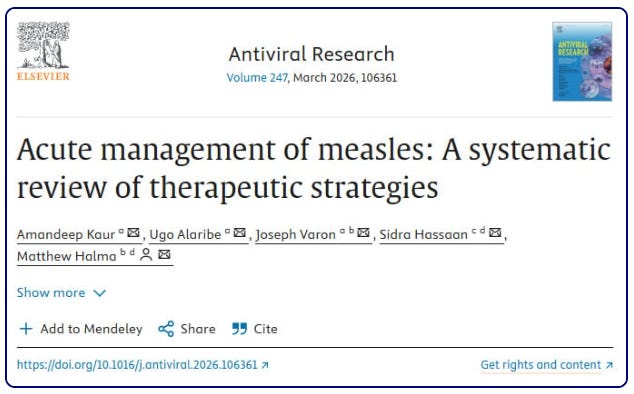
A new peer-reviewed study co-authored by IMA President Dr. Joseph Varon and Director of Research Matthew Halma adds to a growing body of research aimed at exploring therapeutic candidates for measles. Published in Antiviral Research, this systematic review compiles clinical evidence for treatment options—the kind of information that could help patients and physicians make informed decisions. So why isn’t it part of the conversation?
“Adjunctive therapies, including Vitamin A, Ribavirin, and Interferon-α, and emerging antiviral candidates, play an important role in reducing complications… Continued research is urgently needed to validate novel antivirals and immunomodulatory treatments.” — Study authors
📖 Read and Download the Full Paper
Acute management of measles: A systematic review of therapeutic strategies Authors: Amandeep Kaur, Ugo Alaribe, Joseph Varon, Sidra Hassaan and Matthew Halma
About the Study
The research team analyzed 10 studies on acute measles treatments, including six clinical trials, synthesizing the best available evidence into a single resource. It’s the kind of rigorous review that should inform the conversation but rarely does.
Putting Risk in Perspective
Before diving into treatments, it’s worth stepping back from the headlines to look at what the measles data actually shows.
Measles mortality declined 98% before the vaccine was introduced. Between 1900 and 1963, deaths dropped from 13.3 per 100,000 to 0.2 per 100,000. This drop was driven by improvements in sanitation, nutrition, and healthcare. The vaccine arrived after this dramatic decline was already underway.
Outcomes depend heavily on underlying health. The study notes that case fatality rates range from 0.1–0.3% in high-income countries to 3–6% or higher in low-resource settings. The difference? Nutrition, sanitation, and access to care.
Vitamin A deficiency is a major factor. In the United States, 92% of hospitalized measles patients are vitamin A deficient. This suggests that severe outcomes often reflect underlying nutritional issues rather than the virus alone.
None of this minimizes the reality that measles can be serious for vulnerable individuals. But it does suggest that the wall-to-wall fear in media coverage may not reflect the actual risk for most people in developed countries.
What the Research Shows: Therapeutic Candidates
Here’s what the research supports:
🍊 Vitamin A: Addressing a Critical Deficiency
Vitamin A supplementation is the most consistently validated therapeutic candidate for measles. Even the World Health Organization recommends it for all children with severe measles infection. This guidance is often overlooked in high-income countries, but the data strongly supports it.
The evidence for vitamin A:
Multiple randomized controlled trials and meta-analyses show high-dose vitamin A (200,000 IU for children, 100,000 IU for infants, for two consecutive days) significantly reduces measles-related mortality.
Benefits are attributed to vitamin A’s immunomodulatory effects and its role in maintaining epithelial integrity, which helps prevent secondary infections.
Effects are most pronounced in malnourished or deficient populations. But, given that 92% of hospitalized US cases are vitamin A deficient, this is highly relevant domestically.
IMA 2026 is Coming April 17-18!

Join us for the 2026 IMA Medical Education Conference: Emerging Trends in Medicine, a two-day gathering dedicated to the latest innovations, research, and forward-thinking practices shaping the future of healthcare in Las Colinas, Texas—just minutes from Dallas and Fort Worth.
💊 Antivirals: Off-Label but Supported by Evidence
While no antiviral is FDA-approved for measles, two have clinical trial support:
Ribavirin is a broad-spectrum antiviral used off-label in severe or immunocompromised cases.
Interferon-α was evaluated in a randomized study of pediatric measles patients.
Both are generally reserved for severe cases, particularly in immunocompromised patients who have difficulty clearing the virus.
🏥 Supportive Therapies
Immune globulin (IVIG): Provides passive immunity for high-risk individuals, including immunocompromised patients and those on chemotherapy.
Antibiotics: While not antiviral, antibiotics like co-trimoxazole play a role in preventing secondary bacterial infections like pneumonia, a leading cause of measles-related deaths in resource-limited settings.
Vitamin C and Vitamin D: Supports immune function and help manage oxidative stress from illness.
🔬 Investigational Therapies
The study also highlights promising candidates in development:
ERDRP-0519: A polymerase inhibitor that prevented clinical disease and improved survival in non-human primates.
Monoclonal antibodies: Targeting the measles fusion protein to block viral entry.
These remain experimental but represent a growing pipeline of options.
From Research to Real-World Care
This systematic review is part of IMA’s broader commitment to providing complete, evidence-based information on measles—something that’s been notably absent from mainstream coverage.
IMA Senior Fellow Dr. Elizabeth Mumper, a pediatrician with decades of experience, has been educating families on measles facts, treatment options, and vaccine considerations through IMA’s Kid’s Corner series and media appearances. This new peer-reviewed study adds rigorous, published evidence to support what IMA has been saying: measles is manageable, and patients deserve the full picture.
For more resources on measles, check out these guides from IMA:
🧠 Fund Research That Changes Lives
Research like this doesn’t happen overnight. Our team of dedicated experts—physicians, researchers, and clinicians—invest countless hours reviewing evidence, conducting studies, and translating complex findings into practical guidance that patients and practitioners can actually use.